
Androgenetic Alopecia Explained: Male & Female Pattern Hair Loss
Androgenetic Alopecia Explained: Male & Female Pattern Hair Loss
Hair thinning is extremely common, but understanding why it is happening is an important first step toward choosing the right treatment. At Freedom Clinic Toronto, one of the most common conditions we identify during a trichology consultation is androgenetic alopecia (AGA)—better known as male pattern baldness or female pattern hair loss.
Androgenetic alopecia is a progressive form of hair loss influenced by genetics and androgen activity. While it can affect both men and women, the pattern and severity of thinning can look quite different.
The good news is that early identification and a consistent, long-term treatment plan may help slow progression, preserve existing follicles, and improve the appearance of hair density.
What Is Androgenetic Alopecia?
Androgenetic alopecia is a common form of pattern hair loss involving the gradual miniaturization of susceptible hair follicles.
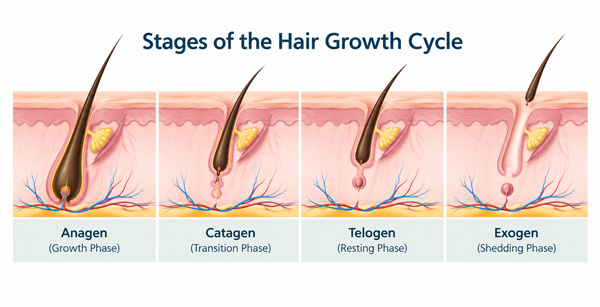
Normally, scalp follicles cycle through different stages of growth and rest. The primary phases include:
- Anagen: the active growth phase
- Catagen: a short transitional phase
- Telogen: the resting phase
- Exogen: the stage during which the hair fibre is released and shed
In androgenetic alopecia, genetically susceptible follicles gradually produce hairs that are shorter, finer, and less pigmented. This process is known as follicular miniaturization.
As miniaturization progresses, terminal hairs may gradually become finer, vellus-like hairs. This can cause the scalp to become increasingly visible even before significant baldness develops.
What Causes Pattern Hair Loss?
Androgenetic alopecia is influenced by a combination of genetic predisposition and androgen sensitivity.
One important androgen is dihydrotestosterone (DHT), which is produced from testosterone through the action of the enzyme 5-alpha-reductase. In genetically susceptible follicles, DHT can contribute to progressive follicular miniaturization and shortening of the anagen growth phase.
Importantly, having androgenetic alopecia does not necessarily mean that a person has abnormally high testosterone or DHT levels. The sensitivity of the hair follicle to androgen activity is also an important factor.
Family history can provide useful information, but pattern hair loss can be inherited from either side of the family and may present differently between relatives.
Male Pattern Baldness
In men, androgenetic alopecia is commonly referred to as male pattern baldness or male androgenetic alopecia.
Typical signs may include:
- Recession at the frontal hairline or temples
- Thinning through the frontal and mid-scalp
- Progressive thinning at the crown or vertex
- Increasing scalp visibility
- Reduced hair shaft diameter
- Variation in hair calibre caused by miniaturization
The degree of male pattern hair loss is commonly described using the Norwood-Hamilton classification.
AGA is progressive, but the rate of progression varies considerably. Some men notice gradual changes over decades, while others experience significant thinning at a relatively young age.
This is one reason why early assessment can be valuable. Preserving follicles before advanced miniaturization occurs is generally a more realistic objective than attempting to recover follicles after extensive progression.
Female Pattern Hair Loss
In women, androgenetic alopecia is often referred to as female pattern hair loss (FPHL).
Rather than developing the classic receding hairline frequently seen in men, women often experience more diffuse thinning through the central, frontal, and upper scalp.
Common signs of female hair thinning may include:
- A widening central part
- Reduced density through the top of the scalp
- Increased scalp visibility
- A smaller or thinner ponytail
- Progressive reduction in hair shaft diameter
- Miniaturized hairs visible during trichoscopic examination
The frontal hairline may remain relatively preserved even when significant thinning is occurring behind it.
Female pattern hair loss may be assessed using classifications such as the Ludwig or Sinclair scales, depending on the presentation.
Hair Shedding Does Not Always Mean Pattern Hair Loss
One of the most important parts of a trichology assessment is determining whether increased shedding represents androgenetic alopecia or another hair loss condition.
For example, telogen effluvium (TE) can produce significant diffuse shedding following triggers such as illness, nutritional deficiencies, medications, hormonal changes, major stressors, or other physiological disturbances.
It is also possible to have telogen effluvium and androgenetic alopecia at the same time. Increased shedding can sometimes make previously subtle pattern hair loss more noticeable.
Other conditions may also need to be considered, including traction alopecia, alopecia areata, inflammatory scalp disorders and, in appropriate cases, scarring alopecia.
Correct identification matters because different forms of hair loss require different approaches.
How Does a Trichologist Assess Androgenetic Alopecia?
A trichology consultation involves more than simply looking at how much hair is present.
At Freedom Clinic Toronto, assessment may include a detailed hair-loss history, family history, evaluation of shedding, scalp examination and microscopic or trichoscopic assessment of the hair and scalp.
We look for findings such as:
- Hair shaft diameter variability
- Follicular miniaturization
- Increased numbers of finer or vellus-like hairs
- Changes in overall density
- Distribution and pattern of thinning
- Signs of excessive shedding
- Scalp erythema, scaling, sebum or inflammation
- Evidence that may suggest another form of alopecia
When appropriate, additional investigation may be recommended. This can include blood testing or referral to a physician or dermatologist when a medical assessment, prescription treatment, or scalp biopsy is indicated.
Can Androgenetic Alopecia Be Treated?
Androgenetic alopecia should generally be viewed as a long-term condition requiring long-term management.
There is rarely one treatment that is appropriate for every patient. Instead, an effective hair-loss program should consider the patient’s diagnosis, age, sex, degree of miniaturization, scalp health, medical history, rate of progression and treatment goals.
Depending on the individual, management options discussed with the appropriate healthcare professional may include:
Minoxidil Topical or medically supervised oral minoxidil may be used to support hair growth and help maintain existing density.
5-Alpha-Reductase Inhibitors
Medications such as finasteride or dutasteride may be considered in appropriate patients under medical supervision. These treatments target the conversion of testosterone to DHT.
Freedom Clinic Medical TrichoBoost
For appropriate patients, Freedom Clinic Medical TrichoBoost may be incorporated into a long-term treatment program for androgenetic alopecia. This compounded topical formulation combines Minoxidil 5%, Finasteride 0.25% and Bimatoprost 0.3% and is applied directly to areas affected by thinning and follicular miniaturization. By combining multiple active ingredients in a single topical formulation, TrichoBoost is designed to support hair growth, help maintain existing density and address the progressive miniaturization associated with pattern hair loss.
Anti-Androgen Therapy
For appropriate female patients, physicians may consider anti-androgen treatments such as spironolactone depending on the patient’s medical history and clinical presentation.
Low-Level Laser Therapy (LLLT)
LLLT uses specific wavelengths of light as a non-invasive adjunctive approach to supporting hair growth in suitable patients.
Platelet-Rich Plasma (PRP) & Exosome Therapy
PRP uses a concentration of the patient’s own platelets and associated growth factors to help support follicular activity and hair growth. Exosome therapy may also be incorporated into a broader hair restoration program to support cellular signalling and the follicular environment. PRP and exosomes may be used individually or in combination for appropriate candidates as part of a comprehensive, long-term treatment plan.
Scalp Health & Freedom Clinic Medicated Shampoo
Treating androgenetic alopecia is not only about the hair follicle. Scalp health is an important part of a comprehensive trichology treatment plan, particularly when pattern hair loss occurs alongside seborrheic dermatitis, dandruff, excessive scaling, sebum accumulation or scalp inflammation.
Freedom Clinic Medicated Shampoo
formulated with 2% Zinc Pyrithione, is used to help control dandruff, seborrheic dermatitis and mild-to-moderate psoriasis while reducing scaling and maintaining a cleaner, healthier scalp environment. For patients experiencing both androgenetic alopecia and an inflammatory scalp condition, managing the scalp can be incorporated alongside treatments directed specifically at follicular miniaturization.
The most effective approach is often not a single treatment, but a carefully selected combination of therapies addressing follicular miniaturization, androgen activity, hair growth and scalp health. At Freedom Clinic Toronto, treatment plans are individualized based on the findings of the patient’s trichological assessment and, when appropriate, coordinated with a physician or dermatologist.
Why Early Treatment Matters
Hair follicles affected by androgenetic alopecia usually do not change from thick terminal hairs to extremely fine hairs overnight. Miniaturization is generally progressive.
This creates an important treatment window.
The earlier pattern hair loss is identified, the greater the opportunity may be to protect existing hair, slow further miniaturization and maintain density.
Patients sometimes wait until their scalp becomes clearly visible before seeking help. By this stage, considerable miniaturization may already have occurred.
If you are noticing a widening part, receding hairline, thinning crown, reduced density or gradual changes in the thickness of your hair, an assessment can help determine whether androgenetic alopecia is present.
Treatment Is a Long-Term Strategy
Patients should also understand that treating pattern hair loss is not usually a short-term project.
The hair-growth cycle operates over months, not days or weeks. Meaningful changes therefore require time, and treatment response should be evaluated over an appropriate period.
More importantly, treatments that successfully maintain hair generally need to be continued to maintain their benefits. Stopping an effective treatment may allow the underlying androgenetic alopecia to continue progressing.
For this reason, we focus on creating realistic, sustainable long-term treatment plans rather than promising quick fixes.
Start With the Right Diagnosis
Not every receding hairline is androgenetic alopecia, and not every woman experiencing shedding has female pattern hair loss.
Before investing in treatments, supplements, devices or procedures, the first step should be understanding what is actually happening to the hair and scalp.
At Freedom Clinic Toronto, our trichology consultations are designed to assess the pattern of hair loss, degree of follicular miniaturization, scalp health, shedding activity and other factors that may be contributing to changes in density.
From there, an individualized long-term management strategy can be developed and, when necessary, coordinated with a physician or dermatologist.
Concerned about male pattern baldness, female hair thinning or unexplained hair loss?
Book a trichology consultation with Freedom Clinic Toronto to have your hair and scalp professionally assessed and learn which treatment options may be appropriate for you.

A Trichology-Based Approach to Telogen Effluvium at Freedom Clinic Toronto
At Freedom Clinic Toronto, we do not look at excessive shedding as a…
How to Stop Hair Loss: Treatment Options for Men and Women
Hair loss is one of the most common concerns we see at FREEDOMclinic Toronto, and one of…